


Follow Us


insights
September 8
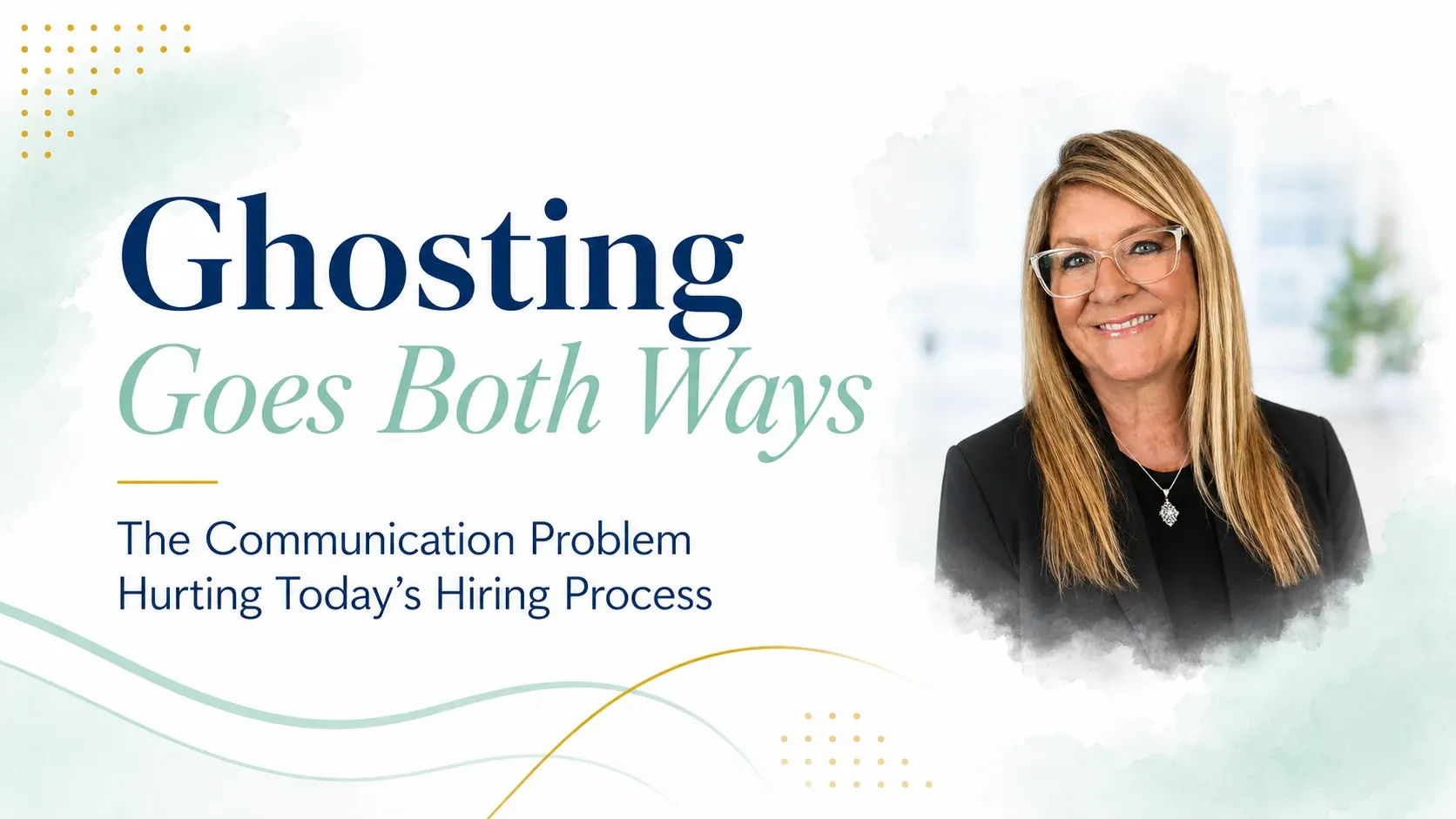
Ghosting Goes Both Ways: Maybe the Real Problem Is Communication
 September 8, 2026
 Gina Brehmer
Key Takeaways
- Candidate ghosting affects both employers and job seekers, highlighting a mutual communication problem.
- Surveys show that 80% of hiring managers have ghosted candidates, while 53% of job seekers have experienced ghosting from employers.
- The communication breakdown occurs when decisions are made without informing the other side, generating uncertainty for both parties.
- Employers can mitigate ghosting by setting clear expectations and maintaining consistent communication throughout the hiring process.
- Building a respectful, open relationship can prevent candidate ghosting and enhance the overall hiring experience.
Estimated reading time: 10 minutes
Table of contents
- Candidate Ghosting Is Frustrating — But There Is Usually Something Behind It
- Employers Ghost Candidates Too
- The Common Denominator Is Uncertainty
- Ghosting Costs More Than a Missed Email
- So What Can Employers Do Differently?
- Where a Recruiting Partner Can Help
- Maybe We Don’t Have a Ghosting Problem. Maybe We Have a Communication Problem.
- Questions Worth Asking
You applied. You interviewed. Everyone said they would be in touch.
And then… nothing.
Most of us have heard the term “ghosting” used in hiring, and unfortunately, it has become pretty common on both sides.
Employers experience it when a candidate stops responding, does not show up for an interview, or accepts an offer and then disappears. Candidates experience it when they apply or interview, are told they will hear back, and then never receive another update.
After years of working with both employers and candidates, I don’t think ghosting is simply a “candidate problem” or an “employer problem.”
I think it is often a communication problem.
- 80% of surveyed hiring managers said they have ghosted candidates
- 53% of surveyed job seekers said they have been ghosted by an employer
- 61% of job seekers said they had been ghosted after an interview
Sources: Resume Genius (2024), iHire (2025), and Greenhouse (2024). The studies use different samples and definitions; the figures are not a single combined dataset.
That tells me this is not about pointing fingers. It is about looking at what is happening in the hiring process and figuring out how we can do better.
Candidate Ghosting Is Frustrating — But There Is Usually Something Behind It
I completely understand why employers get frustrated when a candidate disappears. You have spent time reviewing resumes, scheduling interviews, coordinating with managers, and possibly even turning away other qualified people. Then suddenly the candidate stops responding.
Sometimes they received another offer. Sometimes they changed their mind about the position. Maybe the compensation wasn’t what they expected, the commute became an issue, or something during the interview made them question the fit. Those things happen.
The bigger problem is when no one tells you.
Research from Indeed found that employers experience real consequences from candidate ghosting, including hiring disruption, lost productivity, added workload for recruiting teams, and in some cases onboarding preparations that had already started.
| Employer impact | Reported percentage | What that can mean |
| Hiring disruption | 89% | Candidate drop-off or first-day no-shows disrupt the plan. |
| Time cost | 38% | Time invested could have been used elsewhere. |
| Lost alternatives | 33% | Other qualified applicants may already have been declined. |
| Onboarding already started | 30% | Managers may already have begun planning. |
| Team strain | 30% | Recruiting and hiring teams absorb extra work and stress. |
Source: Indeed survey of 4,517 employers, 2023. Figures describe related but distinct impacts of candidate ghosting.
From my perspective, the goal is not simply to “find candidates who will not ghost.” It is to create enough communication throughout the process that concerns come up before someone disappears. Sometimes one honest conversation can make all the difference.
Employers Ghost Candidates Too
This is the part of the conversation employers sometimes overlook.
Candidates can feel ghosted at almost every stage of the process — after submitting an application, after a phone screen, after one interview, or even after several interviews and assessments. And the further someone gets into the process, the more time and energy they have invested.
iHire did a survey of 1,024 candidates and found that 53% of those candidates admitted to being ghosted even after following up. Out of these candidates, they were then asked when they were ghosted and the results were shocking:
| Where candidates say ghosting happens | Share of respondents | Why it matters |
| After application | 28% | A basic acknowledgment or status update still matters. |
| After one interview | 20% | The candidate has invested real time and expects closure. |
| After initial phone screen | 16% | High volume does not eliminate the need for communication. |
| After multiple interviews | 11% | Silence becomes more damaging as investment increases. |
Source: iHire survey of 1,024 candidates, October 2025. Percentages reflect where respondents said employer ghosting occurred and can be multiple-response; additional responses included skills assessments (9%) and offers (4%).
They may have researched the company, prepared for interviews, rearranged their work schedule, taken time off, completed assessments, and started imagining what making a career change might actually look like. Then the communication stops.
I understand why it happens. Hiring priorities change. Budgets get put on hold. An internal candidate appears. A hiring manager gets busy. Candidate volume becomes overwhelming. All of those things are real.
But even when the hiring process changes, the communication should not disappear with it.
Candidate experience is part of your employer brand. Every interaction tells someone something about what it might be like to work with your organization — especially when the answer is “not yet” or “no.”
And in today’s increasingly automated hiring environment, that human connection matters even more. Technology can make recruiting faster. It can help screen resumes, organize information, automate reminders, and manage large candidate pools. But when no person seems to be behind the process, candidates can quickly feel like their resume simply disappeared into a system.
The Common Denominator Is Uncertainty
This is where I think the conversation gets especially interesting.
One study found that the most common reason hiring managers gave for ghosting candidates was that they were still trying to decide who the best candidate was. Other reasons included high applicant volume, uncertainty around culture or skill fit, salary expectations that were over budget, or the position already being filled.
Candidates are making similar decisions. They may realize the opportunity is not the right fit, decide the compensation is too low, receive a better offer, or simply become unsure about making the move.
Many times, ghosting happens because one side has reached a decision — or is struggling with a decision — and the other side has no idea what is happening.
That is why I believe the goal is not to make every hiring decision predictable. It is to make the process understandable.
| What may be happening | What silence creates | A better response |
| Still deciding | Candidate uncertainty and disengagement | Give a realistic update, even if there is no final decision. |
| Compensation or fit concern | Avoidance on either side | Address the concern directly and early. |
| Timeline or priority changed | Confusion about whether the role is still active | Reset expectations and communicate the new timeline. |
| Another offer or change of mind | Employer loses time and alternatives | Candidates should say they are withdrawing rather than disappear. |
Source context: Resume Genius 2024 Hiring Trends Report and Indeed candidate-ghosting findings referenced in the original Dawson & Dawson draft.
Ghosting Costs More Than a Missed Email
When a candidate disappears, an employer may have to restart the search, extend the vacancy, redistribute work among the team, or delay an important project. When an employer disappears, candidates can also lose something — time, other opportunities, confidence in the organization, and sometimes trust in the hiring process altogether.
And that trust issue is becoming bigger. Greenhouse reported that three in five candidates say they suspect they have encountered a ghost job, while its platform data found that 18% to 22% of jobs posted in a given quarter were classified as ghost jobs. Ghost jobs and candidate ghosting are not the same thing, but together they point to a broader trust problem in hiring.
Candidates now share their hiring experiences on LinkedIn, Glassdoor, social media, and within their professional networks. A poor recruiting experience does not necessarily stay between the recruiter and the candidate. It becomes part of the company’s reputation.
So What Can Employers Do Differently?
I don’t believe we can eliminate ghosting completely. People change their minds. Positions get put on hold. Better offers come along. Business priorities change. That is part of hiring.
But we can make communication part of the hiring strategy instead of treating it as something that happens only when we have news.
| For employers | For candidates |
|
|
Where a Recruiting Partner Can Help
This is one of the areas where I believe a good recruiting partner brings real value. We are not simply sending resumes back and forth. We are talking with the candidate. We are talking with the employer. We are asking questions that sometimes neither side feels comfortable asking directly.
| Employer needs | Candidate needs | What a recruiting partner can do |
| Clarity on the role | Clarity on the opportunity | Align expectations before the first interview. |
| Timely feedback | Timely updates | Keep communication moving between conversations. |
| Confidence in fit | Confidence in fit | Surface questions about skills, culture, compensation, and goals. |
| A process that stays on track | A process that feels respectful | Reduce uncertainty when timelines or priorities change. |
Those conversations can surface uncertainty before it turns into silence. How interested is the candidate — really? Is compensation becoming an issue? Has the timeline changed? Is there another offer in play? Does the candidate understand what the company is looking for? Does the employer understand what matters most to the candidate?
Technology and AI can absolutely help us work faster and smarter behind the scenes. But I still believe a person needs to be responsible for the relationship.
That is something we feel strongly about at Dawson & Dawson. Purpose. People. Partnership. is not just a tagline for us. It reflects how we believe recruiting should work. We don’t just want to fill an opening. We want to create the right connection between an organization and a professional — and communication is a big part of making that happen.
Technology should help us become more responsive and more present, not make employers and candidates feel like they are communicating with a system instead of a person.
Maybe We Don’t Have a Ghosting Problem. Maybe We Have a Communication Problem.
Hiring is faster and more automated than it has ever been. Applications can be submitted in seconds. Resumes can be screened quickly. Messages can be automated and interviews scheduled electronically.
But the more technology we add to the process, the more important I think the human side becomes.
Candidate ghosting is real. Employer ghosting is real too.
Instead of asking, “Who is ghosting whom?” maybe the better question is:
“How do we create a hiring process where people know where they stand?”
Candidates deserve respect for their time. Employers deserve honesty and reliability. And both sides benefit when expectations are clear and communication continues — even when the answer is not the one someone hoped to hear.
At the end of the day, recruiting is still about people. And relationships — whether they lead to a hire today, an opportunity six months from now, or simply a valuable professional connection — are built through communication.
Looking for a recruiting partner who believes communication and relationships still matter?
Dawson & Dawson can help bridge the gap between employers and the professionals they want to hire.
Questions Worth Asking
Three questions I think every employer should consider when looking at their hiring process:
You do not need a final decision to communicate. A short update that the process is still moving can prevent uncertainty from turning into disengagement.
Candidates are more likely to be honest about another offer, compensation concerns, or a change of interest when the relationship feels open and respectful.
This is where many processes break down. Whether it is an internal recruiter, hiring manager, or recruiting partner, someone should be responsible for keeping both sides informed.
- Ghosting Goes Both Ways: Maybe the Real Problem Is Communication

- Finding the Right Leader in a World That Won’t Stop Changing
- Remote Hiring: Common Challenges and How Dawson & Dawson Helps You Overcome Them

- Is AI Quietly Killing Your Employer Brand? Here’s How to Fight Back.

- The Business Leader Who Finds the Leaders Who Grow Your Company
- Career Coach (8)
- Employee Retention (5)
- General (10)
- In the News (6)
- Job Seeking Tips/Resources (22)
- Office Insights (5)
- President’s Corner (2)
- Recruiting & Staffing (10)
- Tips Trends & Takeaways (8)
- Trends & Takeaways (5)
Recent Post


Categories
